Category: Devotional

  • Here’s a Strategy to Be More Like Jesus

    Our level of consistency is typically quite noticeable.
    Our level of consistency is typically quite noticeable.

    “He is consistent. ”

    These are the words I want to hear about myself. When I read about Jesus from John’s viewpoint, I see consistency most of all.

    I’m trying to be like that.

    Jesus’ message never changed – not even when the Jews were ready to use the rocks in their hands. (John 10:31) That was the key to attracting new believers. Through the various discourses in John 8, 9 and 10 and beyond, we see new believers following Jesus despite the ones that wanted to kill him. If Jesus had ever made mistake, his entire ministry might have failed.

    The believers saw the consistency in his message. That is powerful. We could do the same thing by remaining true to God’s word in our speech, our actions and our decisions. When we do, people notice.

    But worse, when we don’t – people notice.

    Many Christians are inconsistent in their message:

    • They are doing questionable activities – TV show choices, immodest dress, social drinking …
    • They are not reading their Bibles – yet they tell others they follow what the Bible says
    • They are not in church – they are not doing things to help their faith grow

    If we are to teach God’s word and expect it to spread, it would be a good idea to live God’s word.

    Maybe we have made mistakes in the past, but the time is always right for starting over. We can always develop a reputation as a Christian by just taking the time to do the work.

    • Let’s be diligent and read our Bibles
    • Let’s talk more about why we believe
    • Let’s root out questionable behaviors and habits in our lives

    When someone notices you are consistent, you will know you are on the right track.

  • Doing What Jesus Did

    Woe unto You, Scribes and Pharisees - between 1886 and 1894 - James Tissot (1836–1902)
    Woe unto You, Scribes and Pharisees – between 1886 and 1894 – James Tissot (1836–1902)

    What would Jesus do?

    Most of the time, we fall short of Jesus’ example. Especially in the department of making sure others have an opportunity to hear the truth, we do not deliver as expected.

    If we are supposed to teach others the gospel, and we are supposed to follow his example, then we also have to teach the hard lessons too.

    In John 8:21-30, Jesus is in the temple teaching and he makes some pretty direct statements to the Jews that were gathered around. For us, “You will die in your sins …” (John 8:24) is not exactly something we can work into every conversation. We might lose a few popularity contests over it, but it is a point that we need to teach.

    Jesus never failed to tell someone what they needed to hear – even if it was a little uncomfortable. The climate for Christians today is not very favorable for telling others about Christ and their salvation. Just like in Jesus’ time, most will not believe, but it is still something that needs to be done.

    And if we are going to do what Jesus did, we need to get started – because there are some that will believe! (John 8:30)

  • How to Avoid Dividing the Church

    Bible Study. The way to find the truth (Acts 17:11)
    Bible Study. The way to find the truth (Acts 17:11)

    They didn’t take time to find out where Jesus was born. (John 7:42)

    They said no prophet ever came from Galilee. (John 7:52)

    When I read about the crowd dividing over who Jesus was, (John 7:40-52) I can’t help but think how people are still the same. Why is it that so many choose sides on an issue without doing an actual investigation?

    Since the Pharisees involved in this account knew that the Christ was supposed to come from Bethlehem, (Micah 5:2) we can tell they were only making an assumption that Jesus was born in Galilee. They also forgot that Jonah was from Galilee, (2 Kings 14:25) so we can see their logic was faulty from the beginning.

    Using that faulty logic, they concluded that Jesus could not be the Christ.

    We have hundreds of denominations of Christian churches. We have thousands of congregations within the denominations further dividing the Scriptures in incorrect ways. All of these based on incorrect conclusions from study or lack of study.

    Christianity is not a religion we are born into. We have to hear it and believe it. (Romans 10:17) We have to study it diligently. (2 Timothy 2:15 KJV) We have to verify what we are taught. (Acts 17:11)

    Yes, Christianity is a lot of work. The reason we have so many that are missing the mark, honestly or not, is because we have failed to give it the diligence required.

    From Paul’s writing, we can see that division in the church was never intended. (Ephesians 4:1-6) If our task is to read and understand God’s word, why would we allow divisions among Christians to stand without proper and honest Bible study together?

  • Faith is a Work

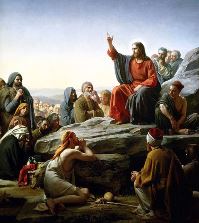
    Carl Heinrich Bloch (1834–1890) - The Sermon On the Mount
    Carl Heinrich Bloch (1834–1890) – The Sermon On the Mount

    Jesus answered them, “This is the work of God, that you believe in him whom he has sent. – John 6:29

    This is a key verse to debate those who teach the “faith only” doctrine. Those who have allowed themselves to believe that there is nothing one can do to be saved have overlooked this verse.

    There is also a difference in believing “in him” and “believing him.” If we are to believe in Christ, we have to trust that what he said is the way of salvation. Finding ways around his teaching is contrary to the spirit of what Jesus was about. A number of the followers turned away in John 6 when they started figuring this out.

    Jesus marveled at man’s disbelief. (Mark 6:6) His villagers even used the fact that he was born among them and therefore could not possibly be worthy of his claims.

    • Not believing in God makes us equal to the animals
    • Not believing is contrary to human nature
    • Not believing leaves man without hope
    • Not believing closes the mind to the evidence of God

    Faith takes a lot of work. It is how we separate ourselves from the world. It is how we decide to set priorities for “spiritual bread” over the physical bread.

    As we make our daily choices – let’s pay more attention to which bread we are working for by choosing to enrich our faith.

  • What Makes Christ Angry?

    Christ driving the Traders from the Temple - ~1600 - El Greco (1541–1614)
    Christ driving the Traders from the Temple – ~1600 – El Greco (1541–1614)

    Jesus was A.N.G.R.Y!

    And rightly so.

    Can you imagine how threatened the moneychangers must have felt when a young and buff man with a whip came tearing through the temple? (John 2:13-22) It certainly made a lasting impression, because the Sadducees were out to get him from then on.

    Jesus tends to get caricaturized as a soft and gentle man. That was not always true, as we see in this event. Our Lord was not afraid to be forceful in defending his father or his father’s house.

    Many that would criticize the Jews today for their treatment of the temple have little room to talk. Today we see church meeting houses mistreated both during services and other times.

    Depending on the denomination or liberality of the congregation we see:

    • Cake sales
    • Dances
    • Sports
    • Secular or para-Christian ceremonies
    • Amusement for children during worship
    • Theatrical productions

    …the list goes on.

    I don’t want to say that our modern meeting houses are in any way like the Jewish temples. We have no scriptural basis for our buildings to be considered holy. The building is just a house.

    But… would Jesus care about what was happening inside a house with his name on it? When the world looks in from the street, would they see only what Jesus would approve of?

    If we look at 2 John 1:8-11, we get the right answer:

    We do not allow the things that Jesus would not teach in our house. (2 John 1:10)

    Even greeting them that would bring it makes us participants! (2 John 1:11)

    Challenge: What is going on in your meeting house that would make Jesus angry?

  • Our Cycle of Foolishness

    On the Road to Emmaus - ~1310 - Duccio (1260–1318)
    On the Road to Emmaus – ~1310 – Duccio (1260–1318)

    They were a little reluctant to believe.

    And why not? The prophesy of the Messiah rising from the dead was something they knew would happen, but were they supposed to believe it was happening right before them?

    Jesus called the two on the road to Emmaus foolish for doubting. (Luke 24:25) They had been taught this stuff all their life. They knew he was out there teaching and doing miracles. They knew this was all supposed to happen just like it did.

    Even for his disciples, it was a lot to take in.

    Sometimes we are reluctant like that. We read and study the Bible, learn what God can do for us, receive his blessings – and then doubt.

    • We are reluctant to pray for what we really need.
    • We are amazed when the prayers are answered.
    • We are reluctant to pray the next time we are in need.

    And so the cycle goes.

    A little faith goes a long way. (Luke 17:6) Take what you have by nurturing it through study (Romans 10:17) and use it to do great things for the Lord. (Hebrews 11:6)