Stoning of St Stephen – ~1435 – Paolo Uccello (1397–1475)
Acts 8:1 says Saul approved of the execution of Stephen.
He thought he was doing God’s will – all the way up until he met Christ in a vision on the way to Damascus in Acts 9
At any given time on our Christian walk, there is more we need to know. No matter how mature in the word we think we are, there are corrections to make and more understanding we can gain.
There are many “versions” of God’s word being taught in the world, but only one we will be compared with at the judgment.
The way to find the right one is go to the source.
Bible Study. The way to find the truth (Acts 17:11)
They didn’t take time to find out where Jesus was born. (John 7:42)
They said no prophet ever came from Galilee. (John 7:52)
When I read about the crowd dividing over who Jesus was, (John 7:40-52) I can’t help but think how people are still the same. Why is it that so many choose sides on an issue without doing an actual investigation?
Since the Pharisees involved in this account knew that the Christ was supposed to come from Bethlehem, (Micah 5:2) we can tell they were only making an assumption that Jesus was born in Galilee. They also forgot that Jonah was from Galilee, (2 Kings 14:25) so we can see their logic was faulty from the beginning.
Using that faulty logic, they concluded that Jesus could not be the Christ.
We have hundreds of denominations of Christian churches. We have thousands of congregations within the denominations further dividing the Scriptures in incorrect ways. All of these based on incorrect conclusions from study or lack of study.
Christianity is not a religion we are born into. We have to hear it and believe it. (Romans 10:17) We have to study it diligently. (2 Timothy 2:15 KJV) We have to verify what we are taught. (Acts 17:11)
Yes, Christianity is a lot of work. The reason we have so many that are missing the mark, honestly or not, is because we have failed to give it the diligence required.
From Paul’s writing, we can see that division in the church was never intended. (Ephesians 4:1-6) If our task is to read and understand God’s word, why would we allow divisions among Christians to stand without proper and honest Bible study together?
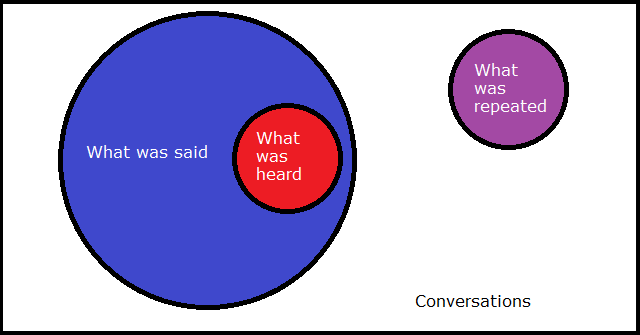
Without thinking about it, we have gotten good at hearing only what we want to hear.
Here’s a picture I drew as a joke:
Our habit of listening and repeating looks something like this
Jesus once quoted Psalm 110:1 to the Sadducees to make the same point. (Luke 20:41-44, Matthew 22:41-46, Mark 12:35-37) How can the Christ be both David’s son and his Lord? Christ was calling them out because they were choosing ignorance of the scriptures for their own convenience.
In all three accounts, Jesus follows up the discussion with a warning about the Scribes. They had gotten a little too used to their lifestyle so they were ignoring God’s word and hoping it would go away.
Christians and non-Christians alike have carried that tradition all the way until now. If we spent more time with the Bible, we would not have so many various “truths.” By doing a better job of reasoning what the Scriptures say, we could all eventually come to the same conclusions.
Jesus never made any bones about it: we are responsible for all of God’s word. Sometimes we have to make hard decisions. Sometimes we have to relearn what we were once taught.
But … so many debates could be eliminated with everyone taking an honest approach to the Bible!
Challenge: Pick one typical day in your life and consider whether each action you take would harmonize with God’s word. If you don’t know, make a Bible study out of it.
Make a connection with an actual Bible and put its contents to memory!
In our world of search engines, we have the ability to search the entire Bible in seconds.
In our world of smartphones, we can do it anywhere and any time.
I know it is a little bit “old school” – but give me a chance on this:
Bible memory work is still a very valuable part of our growth and maturity in the faith.
Sometimes it seems a little “old school” to even carry a Bible to church. The Scriptures used during the service are often projected on a screen making it seem unnecessary to open one at any point in the service.
In order to get to know the scriptures – to get to the point where we know where we stand, we need to get better connected with what it says. I cannot think of any way better to get to know what it says than to memorize the Bible.
Here’s a few thoughts on why. Memorization will …
Clarify the text – When you memorize, the nuances of the text start to appear. The Bible is FULL of great truths that we miss through skimming and mere devotional reading.
Grow our faith – If faith comes from hearing God’s word (Romans 10:17) then committing it to memory can’t help but make stronger Christians
Clean our mind – Our mind returns what we plant in it. Fill it with the good stuff (Philippians 4:8)
Make us ready – We are to be ready in season and out of season (2 Timothy 4:2) What better way to be make a convincing response than to be able to quote the scriptures?
All of the cool devices in the world would have a hard time providing these benefits. They make great supplemental study tools but …
They don’t connect us to or help us fall in love with God’s word!
Challenge:
Take an inventory of Bible scriptures you either know or once knew by heart (There are more than you think!)
Try to think of passages that you know where to find if you need them, but don’t really have memorized.
Work on memorizing everything on the two lists.
By the time you have done this, you will have discovered more passages you want to add to the list. Memorize those too!
The Finding of the Saviour in the Temple – 1860 – William Holman Hunt (1827–1910)
Study.
He did it through study.
After being discovered in the temple studying and talking with the teachers, (Luke 2:46-49) he went home submissive to his earthly parents and…
… Jesus increased in wisdom and in stature and in favor with God and man. – Luke 2:52
The implication is that Jesus, in becoming a man, had to go through all of the growth and phases of becoming an adult. He studied with the teachers and earned their respect as he learned. He grew into manhood just as any child would, by following his father’s lead.
Jesus, the ultimate example and master teacher, even showed us the way to grow in stature in God’s eyes. His expectation for us is to be perfect (Matthew 5:48) and he showed us the path to get there.
Just because people are not perfect and will never be sinless does not excuse us from trying. Depending on your Bible version, 2 Timothy 2:15 says to study (KJV), or to be diligent (NKJV), or do your best (ESV), to be approved by God.
As we work our way down the path toward perfection, we can be encouraged in knowing that Jesus went down the same path, and did the same work!
Most of the time, a difficult Scripture can be worked through logically.
Matthew 9:38-41 is one of those challenging scriptures that have as many explanations as there are teachers of the word. It is an extraordinary example of why we do not take any person’s word without comparing it to what the Bible says.
The disciples experienced a tinge of jealousy when they saw someone who wasn’t a member of their group able to cast out demons in Jesus’ name. The person could have been a follower of John or he could have been one of the 72 (Luke 10:1 ff) after he completed his commission.
Jesus forbid them from stopping him.
Trying to figure out how to apply this teaching has challenged Christians since the gospel was written. Comparing what people teach about it with logic and other Bible passages gives us a good start on how to treat it. Here are a few thoughts I have about what the passage does and does not do for the Christian:
What it doesn’t do:
…allow a church to overlook her members living in a sinful way – we cannot use it as a way out of having “difficult discussions” with fellow Christians
…excuse error and false teaching just because it is in Jesus’ name – we still have to call out and avoid false teachers
…relieve us from trying to teach someone the better way – we are always responsible for teaching the one true gospel
An excellent example of these points can be seen in Priscilla and Aquila. They did not allow Apollos to keep teaching the baptism of John. (Acts 18:24-28)
What it does do:
…tells us not to be judgmental of others solely because they are not among “our group” – this is vastly different from identifying a specific sin and helping someone correct it.
…allows us to give others that believe differently enough room to continue to learn and eventually correct their beliefs – the same goes for us! Don’t forget to allow the possibility that we have it wrong.
…discourages the feeling of jealously of what others are doing at the expense of what we have going for ourselves – The disciples were sitting at the Messiah’s feet but were more worried about what another was doing!
The Parable of the Tares (Matthew 13:24-30) and Hebrews 5:12-6:7 among others can help us resolve these discussion points.
So Here’s the Point
A key part of faith and loving Jesus is keeping his commandments. (John 14:15) When we are reading and studying the Bible, we can never use any of his teachings to get around that basic concept. Some of the improper applications of Mark 9:38-41 try to do just that.
In the same way, what we believe a passage of scripture says should never be in conflict with what another passage says. We can use this simple logical method to make our Bible study a more rewarding experience.