Blog

  • To Tell the Truth

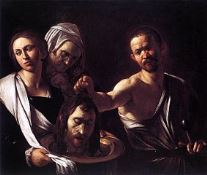
    Solome with the head of John - Caravaggio (1573–1610)
    Solome with the head of John – Caravaggio (1573–1610)

    Previously, in How to Earn Jesus’ Praise, we thought about John the Baptist’s steadfastness in teaching the truth. In Matthew 14:1-12, we get to see how he carried that steadfastness to his death.

    The marriage of Herod to Herodias was unlawful in a number of ways and the Jews detested him for it. According to Josephus and others:

    • He was already married
    • She was his brother’s wife
    • She was his niece

    While the Jews in general did not have the courage to deal with the situation, John made no bones about it. He went to prison for telling Herod he was in an unlawful situation. (Matthew 14:3-4) The truth in John’s mind was more important than his personal safety. He took a risk in a situation where he had enough influence to try to correct it.

    We are hearing more and more about the same type of situation in the news. Those willing to speak up against sinful laws and celebrated lifestyles are finding themselves threatened with financial ruin and endure personal hardships as a result. Some businesses have even made it a condition of employment to remain silent about certain sins.

    The odds are becoming quite favorable that each one of us will have to decide how to act in this scenario. This will be the big test of our own steadfastness. Can you look into a coworker’s eye and tell him you cannot go “have drinks” with him because you believe drinking alcohol is a sin? If not, how would you respond to a larger threat?

    Based on the Biblical examples, we do not have permission to opt out of teaching others about what is sinful. Like John, Pricilla and Aquila, (Romans 16:4) and all the apostles, we have to teach the full counsel of God.

    Now is a good time to practice not being “a reed in the wind.” As Christians we need to become mature enough – to be courageous enough – to say something when we see sin.

    What if we start small and practice on those close to us? Most often, those are the ones who are willing to accept correction given in a loving way.

    Do you have a situation where you could begin practicing?
  • Unbelief

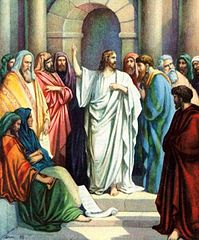
    Jesus teaching in the Temple, from the book Standard Bible Story Readers, Book Five (1928) Authors O. A. Stemler and Bess Bruce Cleaveland
    Jesus teaching in the Temple, from the book Standard Bible Story Readers, Book Five (1928) Authors O. A. Stemler and Bess Bruce Cleaveland

    Matthew 13:58 makes me sad.

    The people of Jesus’ hometown did not get the benefit of his blessings because of their unbelief. If you let that sink in and then read Hebrews 3, we see a similar statement at the end of that chapter:

    ” … they were unable to enter because of their unbelief.” – Hebrews 3:19

    The children of Israel failed to enter the rest because of their lack of faith  – even after all of the signs and miracles they witnessed.

    So many that were born and raised in a Christian family turn away from the God. They have been given the knowledge and lived the lifestyle, but they choose to believe something else.

    They have been warned and God has turned away from them without offering a single blessing. Why bless them when there is no desire for blessings? Why fill needs when they think they don’t need anything?

    There are so many in that precarious state right now – What are some things you can do to help the ones you know?


  • It Takes “One Another” To Make a Strong Church

    Elders and deacons were prescribed and defined as an essential element in building a strong congregation of worshippers. The interesting thing about the qualifications of these positions (1 Timothy 3:1-13, Titus 1:5ff) is that they aren’t intended just for the leadership – all of them describe commandments and goals of Christians in general. (Obviously I am not talking about the ones related to marriage here.)

    It takes everyone

    Christianity involves one another more than self
    Christianity involves one another more than self

    Since every member of the church is required to grow and mature, (Hebrews 6:1-3) it follows that it takes every member working together to make a strong church. When I talk about a strong church, I am talking about just a few basic things:

    • The membership enjoys being together
    • Members are all inclusive and do not tend to clique
    • A high percentage of the membership meet at every opportunity
    • It is easy to find willing contributors
    • The focus is God and not the programs

    There are no “perfect” congregations because the membership is made up of people. The point is that each one is doing everything they can to try to become perfect.

    New Testament Examples of our Responsibility to “One Another”

    Paul made extensive use of the idea that we are responsible for “one another” and depend on “one another.” In the context of strong Christianity, here are a few things he said about the people involved:

    • We should prefer one another (Romans 12:10 KJV)
    • We admonish one another (Romans 15:14 KJV)
    • We have forbearance for one another (Ephesians 4:2)
    • We are kind to one another(Ephesians 4:32)
    • We are forgiving to one another (Ephesians 4:32)
    • We are to encourage one another (1 Thessalonians 4:18)

    The focus of Hebrews on the Membership

    Since the whole point of Hebrews is to change the mind of the Christians backsliding to Judaism – or just outright falling away, the writer spoke directly to the membership to warn and remind them of the part they play in Christianity.

    While leadership in the church is important, it is not the only thing required to keep a group together and motivated. It takes the involvement and example of each and every member of the body. As such, relying on one another is a recurring commandment in the New Testament, as I listed above, and as the Hebrews writer did in at least three places:

    • We are to exhort one another (Hebrews 3:13) – Christians are to rely on each other to get through our weaknesses and temptations. So many of our sins are hidden from our own eyes through their own deceitfulness.
    • We are to provoke or stir up one another to love and good work (Hebrews 10:24) – It is very difficult to attend a worship assembly of a close knit church and come away with no refreshment. The desire to know each other more and to work together grows at every meeting.
    • We are to encourage one another through our attendance (Hebrews 10:25) – It is impossible to be an influence to fellow Christians if we are not there to influence them! We should take advantage of every opportunity to meet with the saints, whether it is a scheduled formal worship or less formal opportunities to study and work together.

    The church is not the preacher.

    The church is not the leadership.

    The church is each and every one of us. The strength of which depends on each and every one of us.

  • How the World Attacks God’s Word

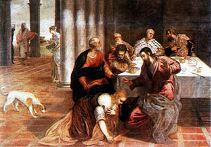
    Jesus at the House of the Pharisees - Tintoretto (1518–1594)
    Jesus at the House of the Pharisees – Tintoretto (1518–1594)

    As I make notes about the opening verses of Matthew 12, I see an amazing picture being drawn. With a quick reading of Matthew 12:1-8 this is what jumps out at me:

    • The Pharisees nitpicking Jesus actions
    • The Pharisees holding their interpretations of the law more sacred than the law itself
    • The Pharisees excusing David’s sinful actions but condemning Jesus’ perfectly legal actions
    • Jesus demonstrating his superior knowledge of the law
    • Jesus using logic to silence the Pharisees

    The leadership of the Jews thought they had a pretty good excuse for resisting Jesus. I say they were in fear for their way of life. They had an opulent setup that had no future if Jesus really was the Messiah. It must be the nature of people to not want to change, because they sure haven’t changed yet.

    The enemies of Christ are still around and they still fear for their way of life. They’re even using the same old tactics against him:

    • People nitpick Christians’ beliefs at every turn
    • People want to hold what they “feel” is right more sacred than God’s word
    • People are tolerant of sin but intolerant of obedience to God’s word

    It is up to us to stand firm against those that are trying to bring down Christ. We are in charge of using our superior knowledge and logic to counter those who want to silence God.

    Would you have known how to argue against the Pharisees in the Matthew 12:1-8 event? What can you change today to get better at defending God’s word?

  • How to Make Jesus Thankful For You

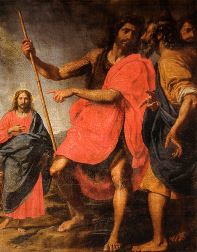
    Jesus (on the left) is being identified by John the Baptist as the "Lamb of God who takes away the sins of the world", 17th century depiction by Vannini.
    Jesus (on the left) is being identified by John the Baptist as the “Lamb of God who takes away the sins of the world”, 17th century depiction by Vannini.

    Previously, we looked at something that Jesus found praiseworthy – that being people willing to stand firm in claiming him and believing in him. There is also an attitude in people that Jesus was thankful for. In Matthew 11:25, he gave thanks for people that aren’t so vain about their wisdom and knowledge that they can take the time to believe in God.

    This bit of scripture is often referred to as “The Great Invitation.” (Matthew 11:25-30) For those willing to listen, Jesus offers a life that no earthly “wisdom” can match:

    • He offers rest – a sinful lifestyle is difficult to maintain and leaves only sadness in the end
    • He offers sympathy – Jesus became one of us, so he knows exactly how we feel when we are troubled
    • He offers help – Jesus’ yoke will help us deal with much more than we can on our own

    Answering Jesus’ call starts with two simple commandments:

    • Love God – Matthew 22:37
    • Love your neighbor – Matthew 22:39

    When you have these two things down – living according to the rest of God’s law is easy.

    What can you change in your life to make Jesus thankful for you?

  • How to Earn Jesus’ Praise

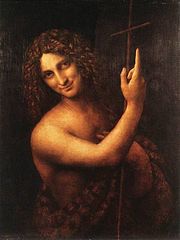
    John the Baptist - Leonardo da Vinci (1452–1519)
    John the Baptist – Leonardo da Vinci (1452–1519)

    If Jesus ever gave a higher opinion of anyone than he did of John the Baptist in Matthew 11:7-19, I don’t know where to find it in the Bible.

    I particularly like the question, “What did you go out into the wilderness to see? A reed shaken by the wind?” (Matthew 11:7)

    What Jesus noticed first and foremost in John was his steadfastness – Once he knew the truth, he never strayed from it. He never stopped asserting his message even when faced with prison and death.

    The power of the world’s message today depends on Christians that can be bent every which way the wind blows.

    Evolution….

    Homosexuality…

    Social drinking…

    Immodest dress…

    So many that claim to be Christian have softened their resolve against these sins and are willing to overlook them. Some go so far as to participate.

    I realize it is difficult to stand firm against the world. The world will not be pleased with God’s word no matter how we approach it. Jesus proved that to us when he contrasted John’s and his lifestyles and pointed out the people mistreated them. (Matthew 11:18-19)

    In the end, the ones that Christ will praise will be those who are not shaken by the winds of society. So, like Jesus and John the Baptist, let’s be strong enough to let “Wisdom justify her deeds” (Matthew 11:19b)