Blog

  • We Need More of the Sinner’s Attitude

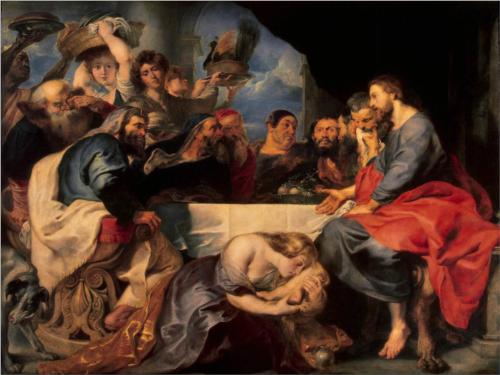
    Christ at Simon the Pharisee - 1620 - Peter Paul Rubens (1577-1640)
    Christ at Simon the Pharisee – 1620 – Peter Paul Rubens (1577-1640)

    “That person has done so much for me. I just love him!”

    We remember those who have given us the most of themselves. Teachers, Coaches, Bosses – people who are in the position to give us something and stand out when they go above and beyond what was required.

    When Jesus went to Simon the Pharisee’s house, the events played out to illustrate that part of our nature. (Luke 7:36-50) Esteeming people important to our success is fine, but here we have a warning of how we handle it as we mature past those needy times.

    The more our situation improves, the harder it is to stay humble and remember those we esteemed so highly.

    Simon thought he was bringing Jesus in to be examined and found the situation turned around on him. Simon, like most of the Pharisees, thought he was in a saved state just because he was a Jew. This goes a long way toward explaining why they had such a hard time accepting the Messiah.

    It reminds me a little of the parable of the Pharisee and the Tax Collector. (Luke 18:9-14) When we can admit our shortcomings, it is easier to humble ourselves and look for a way to correct them. Jesus said there that the “humble will be exalted.” (Luke 18:14)

    In the same way Jesus lifted the sinful woman…

    just like his praise for the honest publican…

    our forgiveness will be most abundant when we are humble in attitude.

    Here’s the warning:

    We are more likely to forget to pray when things are going good for us –

    • When we have plenty of money
    • When we feel like we are living “right”
    • When our relationships are going smoothly

    These are the times we might look at others in a judgmental way.

    These are the times when we forget how much we need a savior.

    Here’s the prevention:

    We need to picture ourselves in the same place as the sinful woman or the publican.

    When we do, we will be more likely to remember to keep Jesus in his esteemed place as our savior. Therefore:

    • We will remember to love him actively.
    • We will remember to talk to God often.
    • We will remember to be genuinely thankful.

    Most importantly…

    We will remember to say, “The Lord has done so much for me. I just love him!”


  • The 10 Insults of Jesus

    The 10 Insults of Jesus

    John Identifies the Christ - ~17th Century - Ottavio Vannini
    John Identifies the Christ – ~17th Century – Ottavio Vannini

    Then:

    “John is crazy!”

    “Jesus is a drunk!”

    The Pharisees rejected God’s righteousness no matter what form it came in. (Luke 7:31-35) John the Baptist was like a hermit and Jesus was very social.

    Now:

    “Those Christians are too exclusive! (or mean!)”

    “Those Christians are hypocrites!”

    If the Bible proves anything, it proves people need more than 2000 years to change. At least … they haven’t changed yet.

    The Challenge:

    It has become very difficult to speak negatively about a number of social issues. When one tries to show what the Bible says about a matter, he is called names. Even if we try to silently live a godly lifestyle and lead by example, there is disdain.

    “You don’t drink any alcohol?”

    “You don’t wear a bikini in public?”

    Those trying to live like a Christian should expect to become conspicuous. They should also plan to be insulted when the time comes to take a stand. Even Jesus had to endure it!

    Once again, the Master Teacher shows us how to live through his own life. No less than ten times we can read about how he dealt with insults and indignities:

    • He was called a glutton (Luke 7:33-35)
    • He was called a winebibber
    • They said he cast out demons by the prince of demons (Matthew 9:34)
    • They called him Beelzebul (Matthew 10:25)
    • They called him a sinner (John 9:24)
    • They said he had a demon (John 7:20)
    • They said he was a Samaritan (John 8:48).
    • They charged him with violating the Sabbath (Matthew 12:2)
    • They referred to him as a “deceiver” (Matthew 27:63)
    • They accused him of friendship with publicans and sinners (Luke 15:2)

    In Luke 7:32, Jesus compared these kind of people to spoiled brats:

    “This game is too happy! It’s not realistic.”

    “This game is too sad! It’s no fun.”

    Children only want what feels good, it takes an adult to want what is right.

    What to do?

    The bottom line is that people will not change until they want to. The best thing we can do (in fact all we are asked to do) is to show them God’s way and live it for ourselves.

    Question: What is the worse confrontation you have had to face trying to live in a godly way? Was there any long term effect on how you live?

  • How Good People Get That Way

    To bear good fruit, the whole tree has to be sound and well fed.
    To bear good fruit, the whole tree has to be sound and well fed.

    What do you think about?

    If you turned off all of your video screens, sat in a chair and looked out a window, what would be the first thing to pop in your mind?

    For as he thinketh in his heart, so is he – Proverbs 23:7a KJV

    If I thought I could get away with it, I would write every day about the content of our thoughts. I would use Philippians 4:8 as the main verse and we would all have it memorized because we would have studied it so much.

    Finally, brethren, whatsoever things are true, whatsoever things are honest, whatsoever things are just, whatsoever things are pure, whatsoever things are lovely, whatsoever things are of good report; if there be any virtue, and if there be any praise, think on these things. – Philippians 4:8 KJV

    Paul knew the importance of the content of our thoughts, and he knew we had to practice good thoughts in order to produce good deeds.

    Think on These Things

    Jesus spent a lot of time with this idea as well. From his teachings we know that we sin as soon as we consider an unlawful act – actually carrying out the action is not required!

    Jesus further taught us to be careful about what is in our heart. He wants us to train our hearts to contain only the good things. He gave us his reasoning in Luke 6:43-45. Go ahead and read that for yourself, but in bullet pointed form he is saying:

    • Good tree = Good fruit
    • Bad Tree = Bad fruit
    • A tree of one kind cannot produce another kind’s fruit

    Therefore: A person’s actions, his speech, his attitude – everything he is – results from what is inside. Everything that is inside was developed from what he put in there.

    Carefully Choose the Inputs

    We have no lack of information. We can feed our minds from so many sources now. This isn’t a bad thing, we are becoming more productive and efficient from all of the great new technology.

    By the same token, just like a cultivated field can be overrun with weeds and trees in a very short time from neglect, so will our thoughts and attention be refocused by poorly chosen entertainment and information.

    Question: What are some ways we can immediately improve the content of our heart?

  • This is How I Turn the Other Cheek

    The Sermon on the Mount - Carl Heinrich Bloch (1834–1890)
    The Sermon on the Mount – Carl Heinrich Bloch (1834–1890)

    If they hate you, do them a good deed.

    If they curse you, bless them.

    If they abuse you, pray for them.

    If they strike, turn the other cheek.

    If they steal from you, give it and more to them.

    Luke 6:27-36 may be the most difficult teachings from Jesus. I don’t know of anyone that truly exemplifies the principles in every way. Even Paul got upset when he was popped in the mouth for his beliefs! (Acts 23:1-3)

    I can’t even say that I’ve heard a sermon that didn’t hedge these teachings a bit. They are taught by making them conditional to the situation or softened by saying they are not absolute commands.

    It does seem to me that if we could master them, there would be very little sport in abusing Christians.

    As Christians, we need to address this passage just like any other – so where do we start?

    Let’s Flip this Around

    We can think about it another way.

    What if we just started treating others better? (And those we like don’t count! Luke 6:32-33) We need to treat those we don’t care for so much a little better – especially fellow Christians and people close to us that we are trying to influence to be Christians.

    Since it is the most used weapon, the logical place to start is with our speech. Look at these:

    • The tongue is a small member that can cause big trouble – James 3:5
    • Corrupt speech is sinful – Ephesians 4:29-31
    • Mind your own business – 1 Thessalonians 4:11, 2 Thessalonians 3:11-12
    • Babbling is ungodly – 2 Timothy 2:16
    • Lay aside the evil thoughts – 1 Peter 2:1

    If we all made an effort to prevent the other person from having to turn the other cheek, we would be rewarded with the same benefit.

    Does that principle sound familiar? (Luke 6:31)

    We can go a long way toward helping others obey the “Love Your Enemies” verses (Luke 6:27-36) by controlling ourselves. I am convinced that this is why Jesus spoke the golden rule (Luke 6:31) right in the middle of teaching us how to react to our enemies.


  • MDP Summary Week of 3/15 – 3/21

    The Finding of the Saviour in the Temple - 1860 - William Holman Hunt (1827–1910)
    The Finding of the Saviour in the Temple – 1860 – William Holman Hunt (1827–1910)

    This week’s study came from the first four chapters of Luke.

    Even during his youth and the weeks we know about the formal start of his ministry, Jesus was influential. We can pick up at any point in his life and learn something from the Master Teacher.

    It is a good thing John the Baptist was sent to prepare the way! Jesus had so much to teach, a teacher was needed to get everyone up to speed.

    Study and Dedication

    In the one little peek we get into Jesus’ youth, we see that he has begun a lifetime of dedication to God. He even snuck out of his parents traveling party to study and read with the men in the temple.

    Following his example is how we get on the right path of obtaining as much perfection as we humanly can. Read along to see …

    How Jesus Grew in Wisdom and Stature

    The Need to Know the Full Gospel

    John had to overcome a big problem trying to teach the Jews: They thought that their bloodline from Abraham was enough to save them.

    He did his best to help them with that, but sadly human nature causes most people to hear only what they want to hear and not what they need to hear. They even go so far as to ignore some parts of the Bible on purpose! This is the same thing as …

    Scoffing At the Truth

    Spreading the Gospel in the Face of the Challenges

    John showed us that material possessions and even food and clothing are the least of our worries. He took his job of making way for the savior very seriously. Through his example, we can know…

    How to Be Steadfast like John

    Facing Temptations

    Before Jesus began his ministry in earnest, he spent at least forty days in the wilderness alone. In order to know us better, he subjected himself to the same physical challenges we have to face daily.

    But –

    What if Jesus Turned the Stone Into Bread?

    Choose the Best

    I am pretty sure that Zig Ziglar said in all of his presentations that he has…

    … got to say ‘no’ to the good so I can say ‘yes’ to the best.

    It turns out that this is a key concept of many ultra-successful people. Guess who else was teaching this during his ministry?

    How Do We Decide What is Better?

    For Next Week

    Beginning today, the New Testament portion of the My Daily Pause reading plan takes us through Luke 5 – 8. Join me in reading the passages (Linked at the top of the web page and updated automatically every day) and spending a little time with God.

  • How Do We Decide What is “Better?”

    Christ in the House of Mary and Martha - 1618 - Diego Velázquez (1599–1660)
    Christ in the House of Mary and Martha – 1618 – Diego Velázquez (1599–1660)

    Learn to say ‘no’ to the good so you can say ‘yes’ to the best. – John C. Maxwell

    I’ve got to say ‘no’ to the good so I can say ‘yes’ to the best. – Zig Ziglar

    John Maxwell and Zig Ziglar, experts on leadership and motivation, both use(d) this quote extensively. Many others can be cited using the same idea with Google and a little time.

    The basic idea is that most wildly successful people achieved extraordinary things because they were able to say the simple word ‘no’ on a routine basis. It doesn’t seem very intuitive, but the concept is simple:

    There is not enough time to address most, much less all, of the worthy needs that request our attention throughout our life.

    In Luke 4:42-44, we see Jesus having to make the same kind of decision:

    Lots of people wanted Jesus to stay in Capernaum to teach and heal them. (We also know that many there did not accept him – Matthew 11:23-24) It would have been easy for Jesus to stay right there until all were healed and he had won over all the nonbelievers.

    Certainly there was disappointment whenever Jesus moved on, but the best use of his short time demanded that he …

    …must preach the kingdom of God to the other cities also – Luke 4:43

    A little Later in the Gospel of Luke, (Luke 10:38-42) we see Jesus demonstrating this again with Mary and Martha. Martha was busy with “the good”, Mary chose “the best.”

    It is a very common mistake, especially in the context of our church participation, to get caught up in the programs. There are programs to feed the poor, care for the elderly, visit the sick – all excellent ideas – helpful and loving ideas. But we see Jesus often stop short of being helpful and loving in favor of teaching.

    He pointed out sins …

    He informed the lost of their condition …

    Sometimes he passed through towns without healing anybody …

    Using Jesus’ example, we know we need to get to work – but choose wisely!

    Doing good work is a key part of our faith, (James 2:26) but our primary and first instruction is to teach and save the lost. (Matthew 28:18-20) This is the assessment we should make every time we are asked to commit to something “good.”