Jesus really nailed how the world would react to him in John 15:18-25.
The world hated him.
The world hated the Apostles.
The world hates God’s word.
You might have noticed the world hates when you talk about God’s word too. Making a reference to the Bible often ends a moral discussion in a stalemate because they hate hearing it.
It is worse when “Christians” do it. More and more, they let opinions, feelings and thoughts take precedence over the written word of God. They have begun to let the world dictate what is acceptable.
They choose what they want over what God wants.
What will get you to heaven – obeying God’s word or popular opinion?
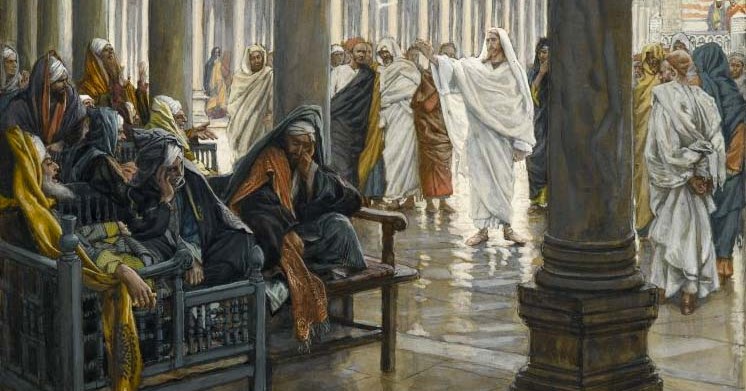
Woe unto You, Scribes and Pharisees – between 1886 and 1894 – James Tissot (1836–1902)
“Faith Only” is doctrine that is easy to accept. What’s not to like? It is safe and there is no work to do.
But it is wrong.
There are many verses in the Bible that contradict “Faith Only” as the way to salvation. John 12:42-43 is a great single passage example. I love it because it makes the point in so few words:
Nevertheless, many even of the authorities believed in him, but for fear of the Pharisees they did not confess it, so that they would not be put out of the synagogue; for they loved the glory that comes from man more than the glory that comes from God.
Here is why this verse shows us there is more to salvation than faith:
They would not confess Jesus – Jesus told us how he feels about that (Matthew 10:32-33)
They failed due to social pressures – They were more interested in what other men thought than what God wants
They did not want to repent – They wanted things to stay like they were.
Is there any way to argue that these people were in a saved state?
Faith simply cannot exist alone. Love and obedience are functionally synonymous with faith and give it life (John 14:15, James 2:17-19)
Complete and total faith is a requirement to be sure, but it is not the end of the road.
Judas might as well have just come out and said it like that. It is what he meant after all. His greed caused him to react inappropriately to Mary’s lavish gift of oil for Jesus. (John 12:1-8)
Mary Magdalene – 1530 – Jan van Scorel (1495–1552)
John comes right out and says that Judas didn’t care for the poor . In fact, John made it clear a few times that Judas had some problems. This day was nothing new. (John 12:6)
There is a couple of reasons why we don’t go around pointing out the sins and shortcomings of others:
There might be something they can say about us.
It is probably (or usually) more blatant than the thing we are pointing out.
This sounds a lot like the speck and the log problem in Matthew 7:3-4.
Jesus resolves this event by pointing out a condition that Judas was not taking into account. (John 12:8) In another situation what Mary did might have been less appropriate. For now though, it was the right thing to do.
There is a time and place to help others with their sins, but we typically need to pay more attention to ourselves.
“Are there not twelve hours in a day?” – John 11:9a
How we choose to use our alloted time is critical
The way the Jews marked time, the daylight was always broken into twelve parts. Winter or summer, there were twelve “hours” of light so some hours were a lot shorter than others.
In the account of raising Lazarus from the dead, Jesus knew the urgency of doing God’s will before his “day” was over. It was dangerous to go back to where he had angered the Jews, but God’s will was most important. (John 11:1-16) Even the disciples sensed this and prepared themselves to face the peril (John 11:16)
We face the same urgency. We cannot be sure how long our “twelve hours” will last.
Following Jesus’ lead, we need to make use of our lifetime to do God’s will – no matter how the world treats us.
Our level of consistency is typically quite noticeable.
“He is consistent. ”
These are the words I want to hear about myself. When I read about Jesus from John’s viewpoint, I see consistency most of all.
I’m trying to be like that.
Jesus’ message never changed – not even when the Jews were ready to use the rocks in their hands. (John 10:31) That was the key to attracting new believers. Through the various discourses in John 8, 9 and 10 and beyond, we see new believers following Jesus despite the ones that wanted to kill him. If Jesus had ever made mistake, his entire ministry might have failed.
The believers saw the consistency in his message. That is powerful. We could do the same thing by remaining true to God’s word in our speech, our actions and our decisions. When we do, people notice.
But worse, when we don’t – people notice.
Many Christians are inconsistent in their message:
They are doing questionable activities – TV show choices, immodest dress, social drinking …
They are not reading their Bibles – yet they tell others they follow what the Bible says
They are not in church – they are not doing things to help their faith grow
If we are to teach God’s word and expect it to spread, it would be a good idea to live God’s word.
Maybe we have made mistakes in the past, but the time is always right for starting over. We can always develop a reputation as a Christian by just taking the time to do the work.
Let’s be diligent and read our Bibles
Let’s talk more about why we believe
Let’s root out questionable behaviors and habits in our lives
When someone notices you are consistent, you will know you are on the right track.
Woe unto You, Scribes and Pharisees – between 1886 and 1894 – James Tissot (1836–1902)
What would Jesus do?
Most of the time, we fall short of Jesus’ example. Especially in the department of making sure others have an opportunity to hear the truth, we do not deliver as expected.
If we are supposed to teach others the gospel, and we are supposed to follow his example, then we also have to teach the hard lessons too.
In John 8:21-30, Jesus is in the temple teaching and he makes some pretty direct statements to the Jews that were gathered around. For us, “You will die in your sins …” (John 8:24) is not exactly something we can work into every conversation. We might lose a few popularity contests over it, but it is a point that we need to teach.
Jesus never failed to tell someone what they needed to hear – even if it was a little uncomfortable. The climate for Christians today is not very favorable for telling others about Christ and their salvation. Just like in Jesus’ time, most will not believe, but it is still something that needs to be done.
And if we are going to do what Jesus did, we need to get started – because there are some that will believe! (John 8:30)




_-_James_Tissot.jpg)