Category: Devotional

  • The Good Confession

    The Good Confession

    Paul mentions the “good confession” twice in two verses (1 Timothy 6:12-13.) We usually refer to moment one confesses that he believes Christ is the Son of God when he is preparing for baptism as the “good confession.”

    Why call it the good confession?

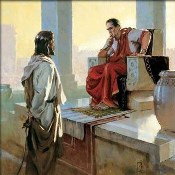
    • Christ made it under oath to Pilate, (Mark 14:62) then he died for making it.
    • God made it at Christ’s baptism (Matthew 3:17)
    • God made it at the transfiguration (Matthew 17:5)
    • God made it before the Greeks (John 12:28)
    • Everyone will eventually make it (Philippians 2:11)
    • It is vital to the plan of salvation (Romans 10:10)
    • Christ will confess those that make it to God (Matthew 10:32)
    • Even angels (Luke 2:11) and demons (Mark 5:7) have made it

    The good confession is the sum total of the Christian doctrine. Everything in the Bible depends on Christ being the Son of God so believing and confessing his name are the first steps to salvation.

    Bonus

    Here are some more who made the good confession:

    • Nathaniel (John 1:49)
    • Peter (Matthew 16:16)
    • Timothy (1 Timothy 6:12)
    • Nicodemus (John 3:2)
    • Thomas (John 20:28)
    • Judas who betrayed him (Matthew 27:4)
    • the judge who tried him (Matthew 27:24)
    • Pilate’s wife (Matthew 27:19)
    • The centurion in charge of his execution (Matthew 27:54)
    • The greater thief on the cross Luke 23:42).

    Daily Bible reading for May 30

    Psalm 149
    Numbers 35-36
    Joel 2:28-3:21
    1 Timothy 6:3-21
  • See Through the Chaff

    See Through the Chaff

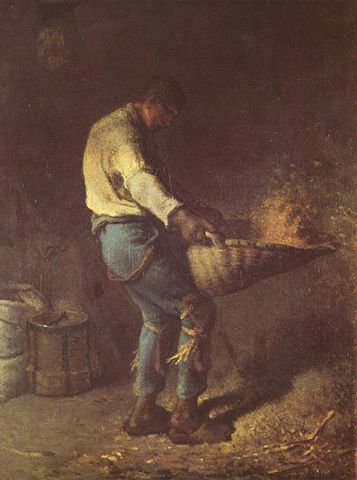
    Le vanneur (The Winnower) - 1846-1847 - Jean-François Millet
    Le vanneur (The Winnower) – 1846-1847 – Jean-François Millet

    He shall be like a tree
    Planted by the rivers of water,
    That brings forth its fruit in its season,
    Whose leaf also shall not wither;
    And whatever he does shall prosper.

    The ungodly are not so,
    But are like the chaff which the wind drives away.
    Therefore the ungodly shall not stand in the judgment,
    Nor sinners in the congregation of the righteous. – Psalm 1:3-4

    His winnowing fan is in His hand, and He will thoroughly clean out His threshing floor, and gather the wheat into His barn; but the chaff He will burn with unquenchable fire. – Luke 3:17


    Chaff is the husks of the wheat seed that is removed before being ground into flour. It is used throughout the Bible as a metaphor for the sin, or sinful people and the treatment they will receive at the judgment.

    We know who or what chaff is, but what does it do?

    For just a minute, I want to think about the military version of chaff rather than the husks and stems in wheat. Chaff is a very simple and effective defensive weapon used to fool missiles and other devices that use radar. It is comprised of flakes and strips of material that are highly reflective to the radar signals. The net result is when chaff is launched into the air, a cloud of this stuff forms around the target and is obscured in a way that causes the weapons to miss it.

    Let’s look at all of the opportunities that the world offers us for diversions and time wasting

    • TV
    • Video games
    • The Internet
    • Hanging out with Friends that don’t share our godly goals

    To keep our chaff metaphor going, one might say that Satan is launching chaff to counter our goal to get to heaven. Nothing is wrong with these activities in and of themselves, but how much is leeched from our visitation, our Bible study or our family time?

    Now think about some of the “overlooked” sins

    • Social drinking
    • Clothing that isn’t as modest as it should be
    • The lottery
    • Dancing

    Even if we are good time managers, many of today’s activities are desensitizing us to things that should be offending us. Even so called family shows and cartoons are riddled with innuendo and “mild” curse words.

    In the end, an active Christian in good standing with his peers might find himself off target when it is all said and done. Just like an experienced radar operator can pick out his target in the midst of the chaff, we need to keep our sights on the target. We became Christians when salvation became our objective. When the chaff is “burned away,” will you still be on course?

  • Growing Tomorrow’s Church

    Growing Tomorrow’s Church

    It doesn’t feel like we are all teaching our children to be the best they can be in God’s kingdom anymore. We need more people that can proclaim the word of God and we need more examples of how great life as a Christian can be.

    In 1 Timothy 3, the qualifications of elders are deacons are laid out and are pretty straight forward. We appoint men that have attained these qualities, but that doesn’t mean we aren’t all supposed to be trying to attain them! These aren’t a list of qualities directed only at local church leadership – these are qualities of Christians in good standing.

    These qualities will give us:

    • Patient and loving fathers
    • Strong families based on God’s pattern
    • Well-grounded teachers
    • Respect from the communities we serve

    I wish we were all teaching our children to desire to become elders in the Lord’s church. I hope we can begin to teach them all to preach a gospel sermon. We can begin by making them all young Timothys by taking an interest in teaching the young ones in Bible class and being sure to always honor the leaders, preacher and other hard working men in the church.

    Daily Bible reading for May 27

    Psalm 146
    Numbers 32
    Joel 1
    1 Timothy 3

  • Lie Detectors

    Lie Detectors

    Guarding against false teaching is a challenge now just like it was when Paul sent Timothy out to preach. (1 Timothy 1:3)

    The first line of defense in protecting the gospel is your ears. Whether you are studying with a person you know well or someone new, listen to what they teach:

    • It should harmonize with what you already know.
    • If it doesn’t, then either you are wrong or they are.
    • This becomes a study point and an opportunity for growth and correction.
    • Ideas that are new to you aren’t necessarily wrong, but are also study points.

    Of course to recognize new, false, different or wrong ideas, you have to be well grounded in the scriptures. This takes some work and commitment, but it is a part of loving God. (John 14:15)

    How do we get that grounding?

    • Study
    • Attending church AND the Bible study sessions.
    • Daily Bible reading
    • Daily Bible study

    If we were all like the Bereans, (Acts 17:11-12) we would all be quick to pick out false teaching and there would be just one church that looks like the church in the Bible.

    Daily Bible reading for May 25

    Psalm 144
    Numbers 30
    Obadiah 1-14
    1 Timothy 1

  • Deciding How to Give

    Deciding How to Give

    We are almost exactly six months from “Black Friday” so it seems like a good time to have a refresher on the spirit of giving. Giving is a subject that to some, is highly personal and sensitive. Some preachers even have a hard time talking about it from the pulpit.

    While the Bible teaches us to be liberal givers, there is some amount of balance required. Solomon stressed a strong work ethic (Proverbs 21:25-26) because of the folly of idleness. Paul taught us to do good for all (Galatians 6:10), but gave a warning in 2 Thessalonians 3:10 to not be careless in our giving, thus allowing some to “work the system”. There are a number of reason why:

    • Idleness is a sin and the recipient is not motivated to work
    • The giver becomes an accomplice to the idleness
    • The truly needy lose out
    • Idleness spreads through the community as a way of life

    probably worst of all, the spirit of giving is stretched thin when idle people are encountered claiming they are needy.

    Paul advised us not to become weary of doing good (2 Thessalonians 3:13) and Solomon taught that generosity creates blessing (Proverbs 22:9).

    Sooooo … How do we balance our charity since there is no quick and easy formula for learning how? Perhaps we gain wisdom from the actual practice of generous giving.

    Daily Bible reading for May 24

    Psalm 143
    Numbers 28-29
    Isaiah 66
    2 Thessalonians 3:6-18

  • God’s Refuge

    God’s Refuge

    In a previous post, we briefly considered the outcome of whether or not we include God in our lives.

    In Psalm 143 we find David hidden in a cave, feeling as low as any man can go. He found himself alone and without the earthly comforts of family and home. If we routinely wait until we are in desperate need to go to God, we might find ourselves in that same darkness and afraid to go forward. Using David’s example we see the way to handle those times of need:

    • He asks God to help (Psalm 142:1-2)
    • He tells God how overwhelmed he is (Psalm 142:3-4)
    • He identifies God as his refuge (Psalm 142:5-7)

    We need to make a habit out of talking to God. When we do, we will start to find ourselves in dark times less often. Refuge in ourselves or in the world will always fail too soon.

    Daily Bible reading for May 23

    Psalm 142
    Numbers 27
    Isaiah 65
    2 Thessalonians 2:13-3:5